



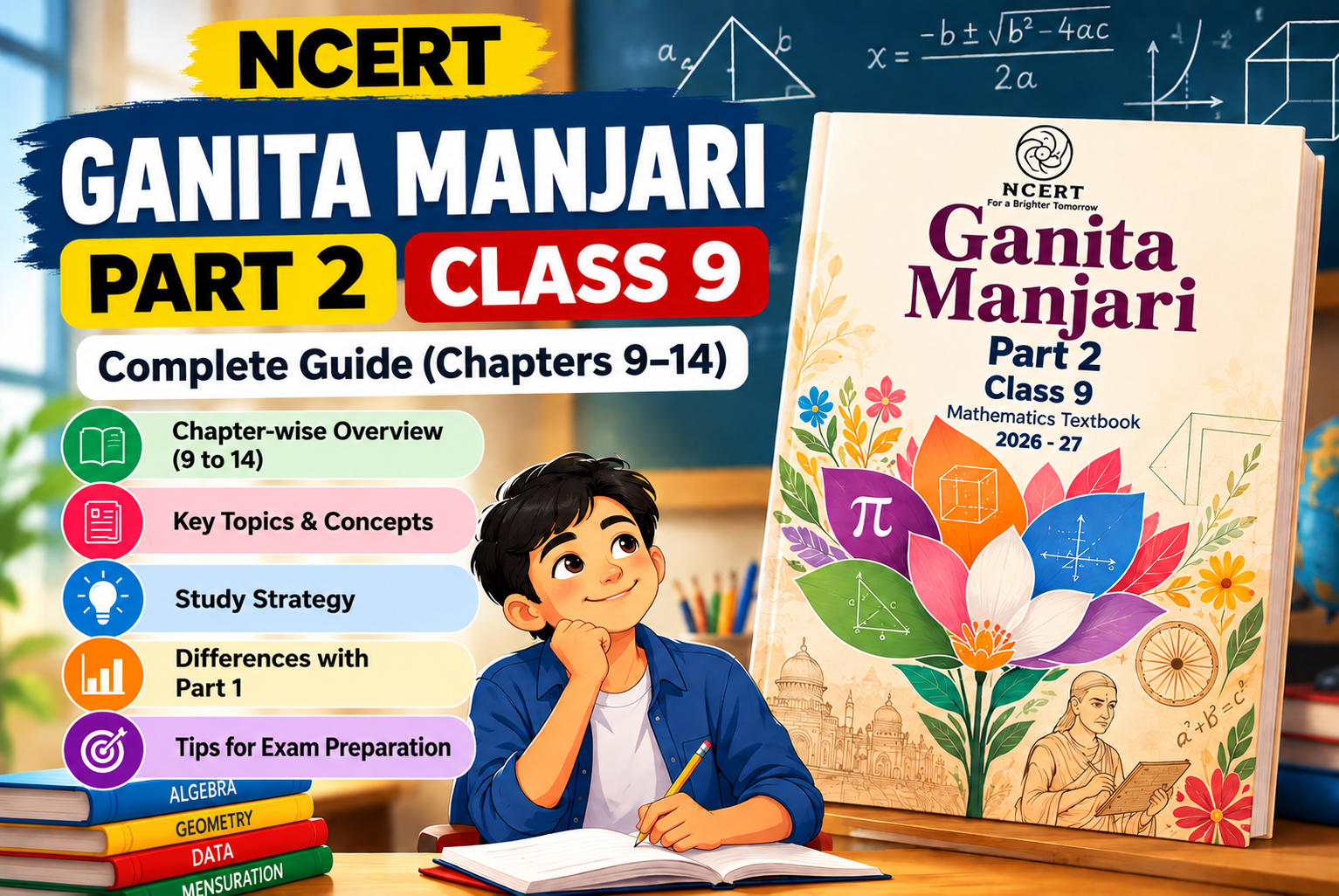
Ganita Manjari Part 2 Class 9: Chapters & Complete Guide 2026-27
Ganita Manjari Part 2 Class 9: Chapters, Topics and Complete Guide 2026-27
Ganita Manjari Part 2 is the second part of the new NCERT Class 9 Mathematics textbook introduced for the 2026–27 academic session.
The new Class 9 Mathematics curriculum takes a different approach to learning mathematics, with greater emphasis on conceptual understanding, logical reasoning, problem-solving, applications, and mathematical thinking.
Ganita Manjari Part 2 continues this approach with six chapters, from Chapter 9 to Chapter 14, covering topics such as mathematical propositions, data, algorithms, quadrilaterals, linear relationships, surface area, and volume.
According to current information about the 2026–27 NCERT textbook rollout, Ganita Manjari Part 2 became available from September 21, 2026. (India Today)
In this article, we will cover the Ganita Manjari Part 2 Class 9 chapters, important topics, differences between Part 1 and Part 2, study strategy, and frequently asked questions.
What Is Ganita Manjari Part 2?
Ganita Manjari Part 2 is the second volume of the new NCERT Class 9 Mathematics textbook for the 2026–27 academic session.
The complete Ganita Manjari Mathematics textbook is divided into two parts:
-
Part 1: Chapters 1 to 8
-
Part 2: Chapters 9 to 14
Therefore, Part 2 contains a total of six chapters. (Nikita Digi Store)
The chapters in Part 2 introduce students to mathematical reasoning, data interpretation, algorithms, geometry, linear relationships, and measurement of three-dimensional objects.
Ganita Manjari Part 2 – Quick Overview
| Information | Details |
|---|---|
| Book | Ganita Manjari – Part 2 |
| Class | Class 9 |
| Subject | Mathematics |
| Academic Session | 2026–27 |
| Publisher | NCERT |
| Total Chapters | 6 |
| Chapter Range | 9 to 14 |
| Availability | September 21, 2026 |
| Curriculum Context | NEP 2020 and NCF-SE 2023 |
Students should refer to the latest official NCERT information for the authorized textbook edition and availability.
Ganita Manjari Part 2 Class 9 Chapters
Ganita Manjari Part 2 contains the following six chapters:
-
Chapter 9 – Propositions and Their Converses
-
Chapter 10 – How Quantities Combine: Understanding Data
-
Chapter 11 – The World of Algorithms
-
Chapter 12 – Quadrilaterals
-
Chapter 13 – Two Variables, One Line
-
Chapter 14 – Math of Space: Surface Area and Volume
This six-chapter structure is reflected in current 2026–27 Ganita Manjari Part 2 resources. (Odinn Classes)
Chapter 9: Propositions and Their Converses
Propositions and Their Converses is the first chapter of Ganita Manjari Part 2.
The chapter introduces students to mathematical statements and logical reasoning.
A proposition is a statement that can be identified as either true or false. Students then explore the concept of a converse and learn how changing the order or structure of a statement can affect its meaning.
For example, if a statement has the form:
If X, then Y.
Its converse can be expressed as:
If Y, then X.
An important concept is that a proposition being true does not automatically mean that its converse is also true.
Students can use counterexamples to examine mathematical statements and determine whether a particular claim always holds. (StudiesToday)
Key Topics
-
Propositions
-
True and false statements
-
Converse statements
-
Logical reasoning
-
Counterexamples
-
Mathematical justification
-
Proving and disproving statements
This chapter encourages students to go beyond calculation and develop the ability to reason mathematically and justify their answers.
Chapter 10: How Quantities Combine: Understanding Data
How Quantities Combine: Understanding Data is Chapter 10 of Ganita Manjari Part 2.
This chapter focuses on understanding data and combining different quantities.
One of the concepts associated with this chapter is the weighted average. Students learn that when different groups or quantities are combined, a simple average may not always represent the combined data correctly. (Boundless Maths)
The chapter also introduces students to ways of representing and interpreting data.
Key Topics
-
Average
-
Weighted average
-
Combining quantities
-
Data interpretation
-
Data representation
-
Charts
-
Comparing data
-
Drawing conclusions from data
Understanding data is an increasingly important mathematical skill because students encounter numerical information in education, business, science, technology, news, and everyday life.
Chapter 11: The World of Algorithms
The World of Algorithms is Chapter 11 of Ganita Manjari Part 2.
An algorithm can generally be understood as a sequence of steps or instructions used to solve a problem or complete a task.
This chapter introduces students to systematic approaches to problem-solving.
Instead of approaching every problem randomly, students can learn to break a problem into smaller steps and follow a logical process toward a solution.
Key Topics
-
Algorithms
-
Step-by-step problem-solving
-
Logical thinking
-
Mathematical reasoning
-
Pattern recognition
-
Systematic problem-solving
Algorithmic thinking is useful beyond mathematics. It is also closely connected with computational thinking and the way problems are approached in technology and computer science.
Chapter 12: Quadrilaterals
Quadrilaterals is the geometry chapter in Ganita Manjari Part 2.
A quadrilateral is a closed geometric figure with four sides.
This chapter focuses on understanding quadrilaterals and the relationships between their different properties.
Students are encouraged to understand geometric properties rather than simply memorize them.
Key Topics
-
Quadrilaterals
-
Properties of quadrilaterals
-
Geometric relationships
-
Theorems
-
Converse statements
-
Mathematical reasoning
-
Geometric proofs
While studying this chapter, students should focus on understanding why a particular property is true and how it can be justified mathematically.
Chapter 13: Two Variables, One Line
Two Variables, One Line is Chapter 13 of Ganita Manjari Part 2.
This chapter focuses on mathematical relationships involving two variables.
Students explore how relationships between two quantities can be represented mathematically and interpreted using different forms.
Key Topics
-
Two variables
-
Linear relationships
-
Equations
-
Algebraic representation
-
Graphical representation
-
Patterns
Understanding relationships between variables provides an important foundation for algebra and graphical mathematics in higher classes.
Students should pay attention to how changes in one variable can affect another and how these relationships can be represented mathematically.
Chapter 14: Math of Space: Surface Area and Volume
Math of Space: Surface Area and Volume is the final chapter of Ganita Manjari Part 2.
The chapter deals with three-dimensional objects and the measurement of their surface area and volume.
Students study how the amount of surface covering an object and the space occupied by an object can be measured.
The chapter includes three-dimensional shapes such as cubes, cuboids, cylinders, cones, pyramids, spheres, and hemispheres. (Boundless Maths)
Key Topics
-
Surface Area
-
Volume
-
Three-dimensional shapes
-
Cubes
-
Cuboids
-
Cylinders
-
Cones
-
Pyramids
-
Spheres
-
Hemispheres
-
Practical measurement
Surface area and volume are also useful in real-life situations involving containers, boxes, tanks, buildings, packaging, and other three-dimensional objects.
Ganita Manjari Part 1 vs Part 2
The Class 9 Ganita Manjari Mathematics textbook is divided into two parts.
Part 1 contains Chapters 1–8, while Part 2 contains Chapters 9–14. (Nikita Digi Store)
| Feature | Ganita Manjari Part 1 | Ganita Manjari Part 2 |
|---|---|---|
| Chapters | 1–8 | 9–14 |
| Number of Chapters | 8 | 6 |
| Class | 9 | 9 |
| Subject | Mathematics | Mathematics |
| Academic Session | 2026–27 | 2026–27 |
| Main Areas | Numbers, Algebra, Coordinates, Probability, Sequences, etc. | Logic, Data, Algorithms, Geometry, Linear Relationships, Surface Area & Volume |
Together, the two parts cover the 14 chapters of the new Class 9 Mathematics textbook structure.
What Is Different About Ganita Manjari Part 2?
Ganita Manjari Part 2 is part of the revised Class 9 curriculum introduced for the 2026–27 academic session.
The new Class 9 textbooks have been introduced in the context of the curriculum reforms associated with NEP 2020 and NCF-SE 2023. (India Today)
The broader approach places importance on developing skills such as:
-
Conceptual understanding
-
Mathematical reasoning
-
Problem-solving
-
Logical thinking
-
Data interpretation
-
Application of mathematical concepts
-
Mathematical communication
This means students should focus not only on obtaining an answer but also on understanding the reasoning and process used to reach it.
How Should Students Study Ganita Manjari Part 2?
Ganita Manjari Part 2 includes topics that require understanding and reasoning. Students should therefore avoid relying entirely on memorization.
1. Understand the Concept First
Read the explanation and examples carefully before attempting the exercises.
Try to understand what the concept means and why it is being introduced.
2. Solve Questions Yourself
Before checking a solution, try to solve the problem independently.
Even when the answer is incorrect, the attempt can help identify where your understanding needs improvement.
3. Focus on Reasoning
Reasoning is particularly important in topics such as propositions and geometry.
Don't only memorize a result. Try to understand how the result can be justified.
4. Practice Different Types of Questions
Your preparation should include:
-
Concept-based questions
-
Application-based questions
-
Reasoning questions
-
Textbook exercises
-
Practice questions
-
Revision questions
5. Revise Regularly
Revise each chapter after completing it instead of waiting until the examination period.
Short revision notes containing important concepts, definitions, formulas, and methods can be useful.
Common Mistakes Students Should Avoid
1. Memorizing Everything Without Understanding
Formulas and methods are useful, but students should understand the concepts behind them.
2. Looking at Solutions Too Quickly
Try the question yourself before checking the solution.
3. Ignoring Reasoning Questions
Topics such as propositions and geometry require logical thinking. Reasoning questions should be included in regular practice.
4. Leaving Revision Until the End
Regular revision makes it easier to remember concepts over a longer period.
5. Practicing Only Easy Questions
Students should gradually include application-based and reasoning-based questions in their preparation.
Ganita Manjari Part 2 Notes and Solutions
Students preparing for Class 9 Mathematics can benefit from chapter-wise learning resources alongside the textbook.
Useful resources include:
-
Ganita Manjari Part 2 Notes
-
Chapter-wise NCERT Solutions
-
Important Questions
-
MCQs
-
Practice Questions
-
Worksheets
-
Formula Sheets
-
Revision Material
-
Sample Papers
Fukey Education can provide these resources chapter by chapter so students can move from concept learning to practice and revision in one place.
For example:
Ganita Manjari Part 2 → Chapter 9 → Notes → Solutions → MCQs → Practice Questions
This type of chapter-wise preparation can make it easier for students to identify areas where they need additional practice.
Where Can Students Get Ganita Manjari Part 2?
Students should use official NCERT sources and authorized channels to obtain the textbook.
According to current information, Ganita Manjari Part 2 became available for sale from September 21, 2026. (India Today)
For digital textbook availability and the latest official information, students should check the NCERT Textbooks Portal.
Important: Students should avoid downloading copyrighted textbooks from unauthorized websites. Use the official NCERT source or authorized sellers wherever possible.
Ganita Manjari Part 2 Chapter-Wise Overview
Here is a quick overview of all six chapters:
| Chapter | Title | Main Area |
|---|---|---|
| 9 | Propositions and Their Converses | Mathematical Reasoning |
| 10 | How Quantities Combine: Understanding Data | Data & Averages |
| 11 | The World of Algorithms | Algorithms & Problem-Solving |
| 12 | Quadrilaterals | Geometry |
| 13 | Two Variables, One Line | Linear Relationships |
| 14 | Math of Space: Surface Area and Volume | Mensuration & 3D Geometry |
The Chapter 9–14 structure is reflected in current 2026–27 Ganita Manjari Part 2 resources. (Odinn Classes)
Frequently Asked Questions About Ganita Manjari Part 2
What is Ganita Manjari Part 2?
Ganita Manjari Part 2 is the second volume of the new NCERT Class 9 Mathematics textbook introduced for the 2026–27 academic session.
How many chapters are there in Ganita Manjari Part 2?
There are six chapters, covering Chapters 9 to 14. (Odinn Classes)
When was Ganita Manjari Part 2 released?
Current reporting states that Ganita Manjari Part 2 became available for sale from September 21, 2026. (India Today)
What are the chapters in Ganita Manjari Part 2?
The six chapters are:
-
Propositions and Their Converses
-
How Quantities Combine: Understanding Data
-
The World of Algorithms
-
Quadrilaterals
-
Two Variables, One Line
-
Math of Space: Surface Area and Volume
Are Part 1 and Part 2 both part of Class 9 Maths?
Yes. Ganita Manjari is divided into two parts. Part 1 contains Chapters 1–8 and Part 2 contains Chapters 9–14. (Nikita Digi Store)
Students should follow the chapters prescribed by their school and applicable curriculum.
Is Ganita Manjari Part 2 based on NEP 2020?
The new Class 9 textbook rollout is associated with the revised curriculum developed in the context of NEP 2020 and NCF-SE 2023. (India Today)
Is Ganita Manjari Part 2 the new Class 9 Maths book?
Ganita Manjari Part 2 is the second part of the new NCERT Class 9 Mathematics textbook for the 2026–27 academic session.
Conclusion
Ganita Manjari Part 2 Class 9 completes the second half of the new NCERT Mathematics textbook structure for the 2026–27 academic session.
It contains six chapters, from Chapter 9 to Chapter 14, covering mathematical reasoning, data, algorithms, quadrilaterals, linear relationships, surface area, and volume.
The textbook places emphasis on understanding mathematical concepts, reasoning, problem-solving, and applying mathematics to different situations.
For Class 9 students, the best approach is to study the textbook carefully, solve examples independently, practice different types of questions, understand the reasoning behind solutions, and revise regularly.
Together, Ganita Manjari Part 1 and Part 2 provide the new Class 9 Mathematics textbook structure for the 2026–27 academic session.
Students can complement their textbook preparation with chapter-wise Notes, Solutions, MCQs, Important Questions, Practice Questions, and Revision Material to strengthen their understanding and practice.


Be the first to comment on this post.